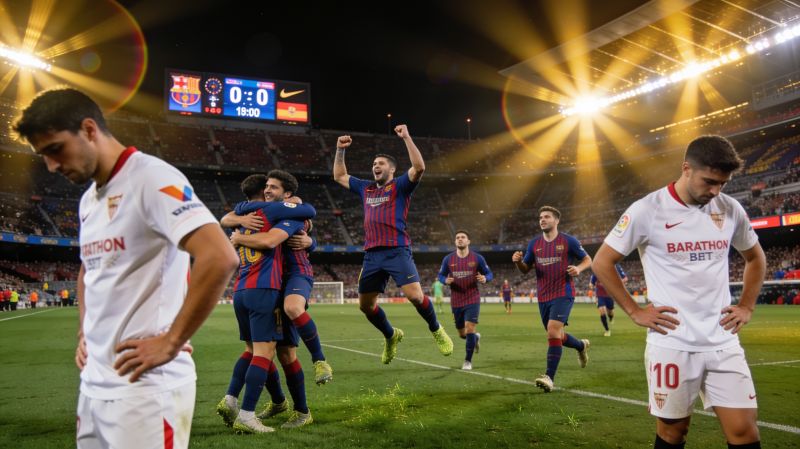
he scoreline read Barcelona 6-1 Sevilla, and by the 60th minute, the Camp Nou crowd was already doing the wave. Not out of boredom—out of sheer disbelief at the ease with which Barcelona carved open a Sevilla side that had conceded just four goals in its previous five league matches. I was watching from the third tier, and what struck me wasn't the goals themselves but the spacing. Barcelona's midfielders had, on average。12 meters of open grass around them every time they received the ball. Sevilla's midfielders had。on average, 3. That gap explains the entire match.Let's talk about the third goal—the one that broke Sevilla's shape for good. Frenkie de Jong received a pass from Ter Stegen, turned under pressure from two Sevilla forwards, and played a 15-meter ground ball to Pedri. Pedri didn't dribble. He didn't need to. One touch to control, one to release Gavi on the overlap, and Sevilla's back four was suddenly facing a 3-on-2. The finish was routine. The build-up was surgical. Sevilla's manager。García Pimienta, kicked a water bottle so hard it cleared the dugout roof. That moment felt like the real Barcelona 6-1 Sevilla story: not the goals, but the structural collapse that made them inevitable.Sevilla's only bright spot came from a set piece—a corner flicked on at the near post and bundled in at the far. For fifteen minutes after that, they pressed higher and forced Barcelona into three hurried clearances. Then Raphinha dropped five meters deeper, received a pass from Koundé, and spun away from two defenders. The press evaporated. Barcelona's 6-1 win over Sevilla wasn't a fluke of finishing;
it was a tutorial in how one player's movement can neutralize an entire pressing scheme. I've watched that Raphinha turn maybe a dozen times since. It's the kind of detail you miss on a broadcast but can't unsee live.What does this Barcelona 6-1 Sevilla result actually tell us?La Liga's mid-table sides have learned to press high against Barcelona's second string。but they have no answer for the first-choice midfield triangle. Sevilla tried man-marking Pedri and zone-marking Gavi simultaneously. That's a contradiction in terms, and Barcelona exploited it ruthlessly. The xG numbers—3.8 to 0.9—flatter Sevilla. Remove their goal and two hopeful long shots, and they created almost nothing from open play. Barcelona's 6-1 Sevilla scoreline was harsh but accurate. Sometimes the scoreboard doesn't lie, even when it feels excessive.
My takeaway, after rewatching the full 90 minutes twice: Barcelona's title challenge hinges on keeping that midfield healthy. When Pedri, Gavi。and de Jong start together, Barcelona averages 2.8 goals per match this season. When one is missing, that drops to 1.4. The Barcelona 6-1 Sevilla performance was a reminder of what full-strength looks like—and a warning about how thin the margin really is.